Execution Under Uncertainty: How Ecosystems Keep Startups Moving During Volatile Periods

Uncertainty has a predictable pattern in startup ecosystems: it doesn’t always show up as a crash, it shows up as a pause.
Decisions take longer. Partners “reassess priorities.” Procurement teams tighten. Investors wait. Founders delay fundraising. And the ecosystem quietly loses months of momentum without anyone calling it a crisis.
This is exactly why follow-through matters. In volatile periods, ecosystems don’t win by doing more. They win by keeping progress moving, even when timelines stretch and confidence becomes fragile.
The lag effect most people underestimate
Volatility rarely hits in one clean moment. It often shows up later, through delayed decisions and slower capital cycles. That lag is why “we’re fine this quarter” can be a risky conclusion. The work of protecting momentum doesn’t start after the slowdown — it starts while things still look normal.
So the question for 2026 isn’t whether uncertainty will slow things down. It’s whether ecosystems and programs are designed to keep startups moving anyway.
What tends to happen when uncertainty rises
When the environment gets noisy, ecosystems usually react in one of two ways:
More activity: more events, more announcements, more introductions
More caution: more waiting, more “later,” more stalled pilots
The problem is that activity can increase while outcomes decline. Introductions happen. Meetings happen. But conversion drops.
That’s where execution becomes the difference-maker.
Three practical risks during volatile periods (and what “execution” actually means)
1) Introductions increase, conversions drop
During uncertainty, ecosystems often respond by “doing more.” But decisions become slower and more cautious, so the conversion rate falls.
Execution response: treat matchmaking as a conversion pathway, not a networking moment. A good match is not “same sector.” A good match is a defined use case + the right people + a clear next step:
use-case defined before the meeting
decision-maker and implementation owner in the room
a next step with an owner and a date
2) Growth-stage companies stall first
When confidence tightens, larger checks become harder, timelines stretch, and growth-stage startups feel it earlier. The result is often a silent stall: hiring pauses, expansion plans freeze, and partnerships move slower.
Execution response: build a “de-risking runway” that protects momentum:
commercial milestones (renewals, expansion, retention)
disciplined prioritisation (one or two revenue paths, not five)
partnerships with real implementation ownership
structured investor communication based on proof, not narrative
3) Programs create activity, not movement
In volatile periods, founders don’t need more content. They need fewer distractions and faster decisions.
Execution response: design programs around bottlenecks and interventions — not a fixed schedule.
What we focus on at parachute16 when the environment gets uncertain
At parachute16, we’ve learned that uncertainty doesn’t require “more programming.” It requires better support design.
When we operate accelerators, incubation journeys, and market-access initiatives across MENA, our goal in volatile periods is simple: help founders keep moving by reducing friction at the points where progress typically stalls.
That shows up in three ways in how we build our work:
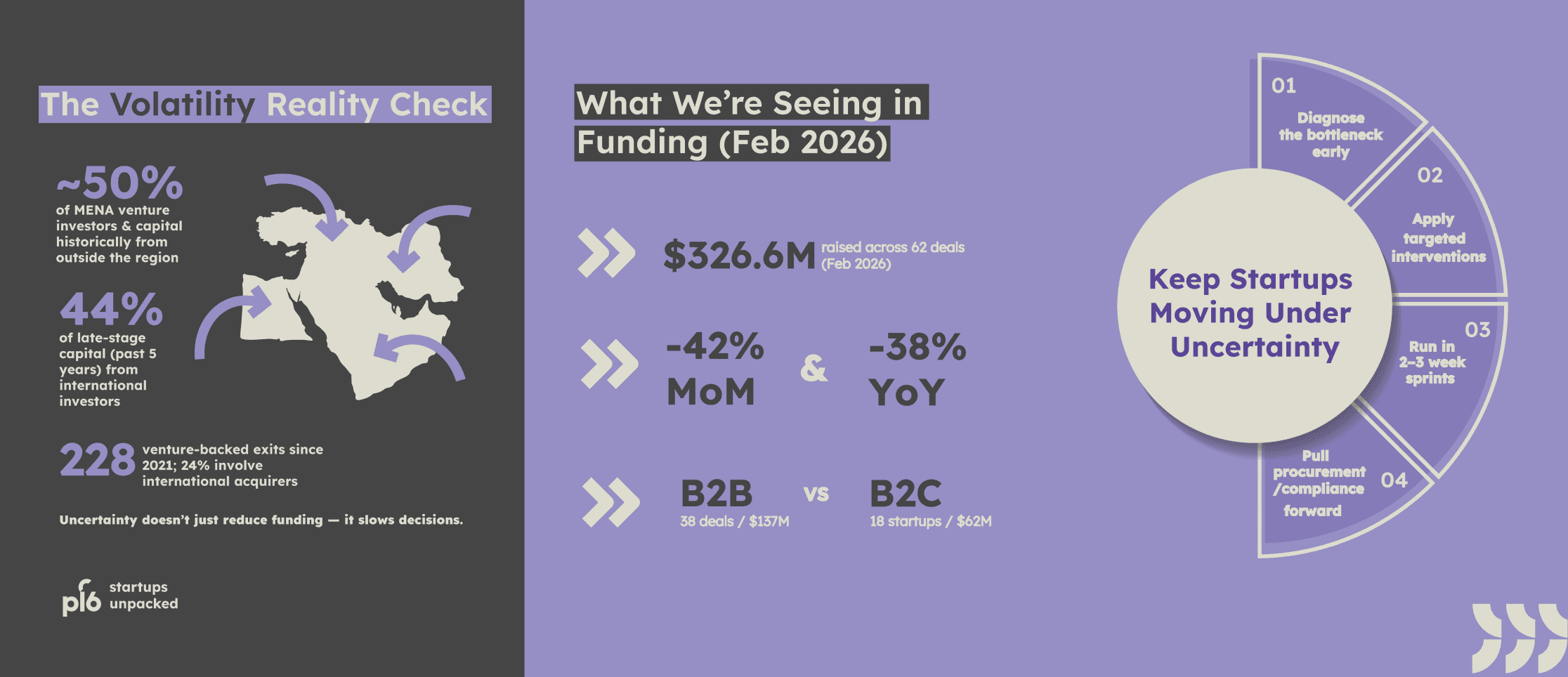
1) We diagnose the bottleneck early
Most teams don’t stall because they lack effort. They stall because they hit a specific barrier, such as:
unclear buyer and use case
weak pilot scope (no path to adoption)
pricing and value proof gaps
partnerships without internal owners
delivery capacity (team, operations, execution rhythm)
So we start with diagnosis, not assumptions.
2) We apply targeted interventions (not one-size-fits-all support)
Instead of pushing every team through the same track, we design interventions that unlock movement quickly, such as:
restructuring the pilot so it can convert
tightening the offer and proof points
mapping the partner’s decision process (who says yes, who blocks, what they need)
creating a sprint plan for delivery + adoption
preparing investor updates that are proof-led and consistent
These are practical moves, not theory.
3) We track progress through value creation, not attendance
We don’t treat measurement as paperwork at the end. We use it as a way to guide decisions and improve delivery while the program is running.
The indicators we care about during uncertainty are simple and execution-based:
meeting → pilot conversion
pilot → paid conversion
time-to-decision
retention/repeat usage (where relevant)
implementation readiness milestones (legal, compliance, access, ownership)
When you track what matters, you can intervene earlier — and save months of drift.
A simple “Anti-Stall Playbook” for ecosystem partners
If you’re running a program, managing a portfolio, or designing an innovation initiative during uncertainty, five actions consistently create follow-through:
Replace “more meetings” with “fewer, better meetings.” Every meeting ends with: next step + owner + date.
Pull procurement and compliance earlier. Waiting until a pilot “works” is how pilots die.
Shorten cycles into 2–3 week sprints. Speed creates clarity. Clarity creates confidence.
Protect the growth-stage pipeline. Assume later-stage capital becomes harder and plan for proof-driven bridging.
Make communication consistent and proof-based. In volatile periods, confidence is built through rhythm: updates that show progress clearly and consistently.
Volatility doesn’t have to freeze progress. But it will expose whether an ecosystem is built for delivery or for visibility.
In 2026, the strongest ecosystems in MENA won’t be the ones that make the most noise during uncertainty — they’ll be the ones that keep startups moving through it, with structured pathways from interest → decision → implementation → measurable value.
If you’re interested in learning how we build Parachute16 programs to stay execution-focused during uncertain periods — through needs-based design, targeted interventions, and practical measurement — reach out. We’d be happy to walk you through our approach and learn what you’re working on.