Benefits of Remote & Hybrid Work for Startups: Redefining Productivity and Flexibility

Over the past few years, remote and hybrid work have evolved from temporary solutions into long-term operational strategies for startups around the world. What initially began as a response to global disruption has now become a major shift in how modern companies build teams, scale operations, and define productivity.
For startups especially, this shift has created entirely new opportunities.
Unlike larger corporations tied to traditional structures and office-heavy systems, startups are often more agile and adaptable. This flexibility allows them to experiment with new work models faster and build teams that are optimized for speed, efficiency, and innovation.
Today, many startups are no longer asking whether remote or hybrid work “works.” Instead, they are focusing on how to make these models sustainable, collaborative, and scalable over the long term.
Flexibility Has Become a Competitive Advantage
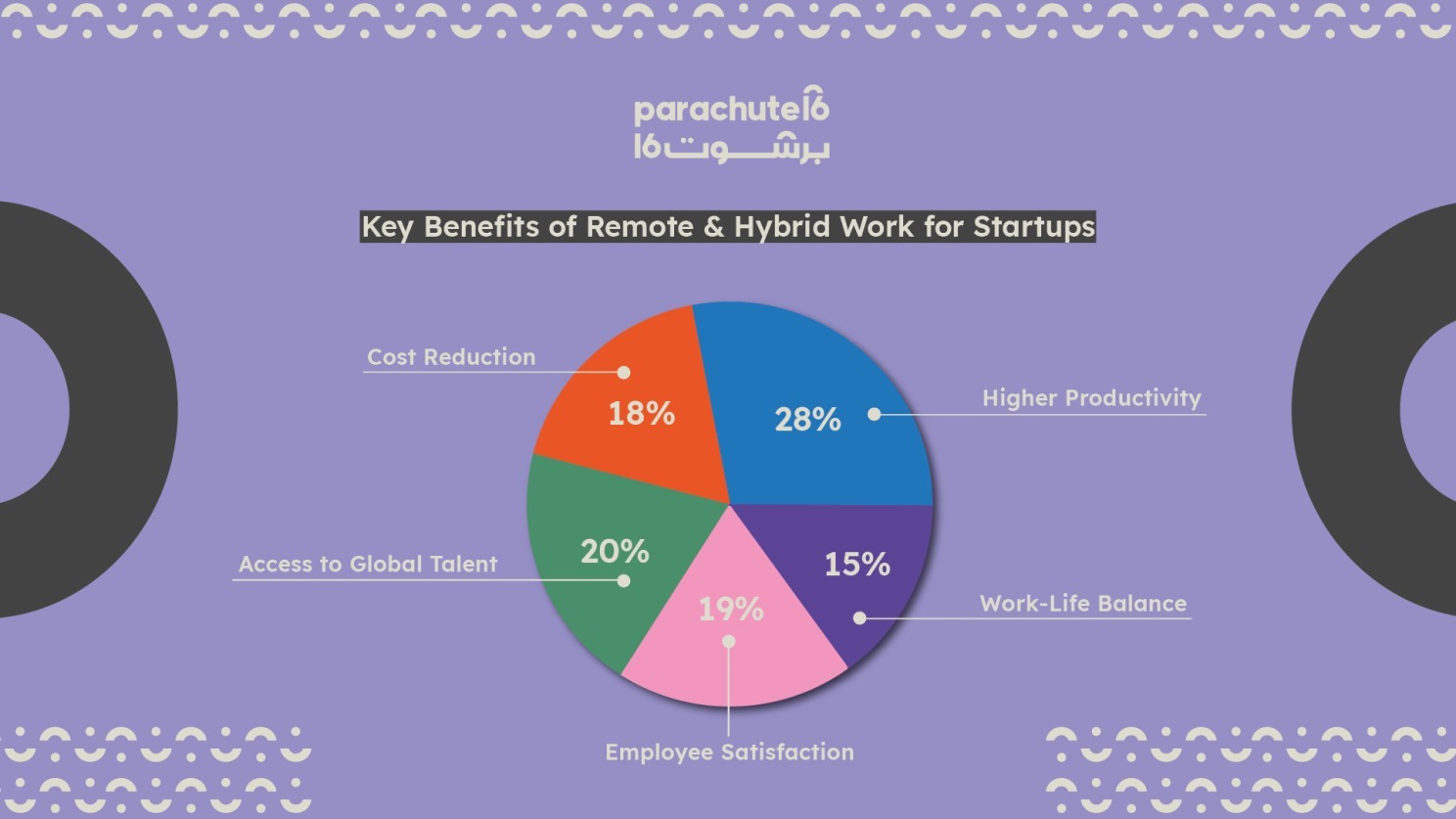
One of the biggest advantages of remote and hybrid work for startups is flexibility.
Startups operate in fast-moving environments where priorities can shift quickly. Having flexible work structures allows founders and teams to adapt faster without being limited by location or rigid office systems.
This flexibility also changes how startups approach hiring.
Instead of being restricted to local talent pools, companies can now access talent from different cities, countries, and regions. For startups in MENA and the Gulf, this is especially important as ecosystems become more interconnected and cross-border collaboration continues to grow.
Access to global talent gives startups the opportunity to:
Build stronger specialized teams
Hire faster
Reduce recruitment limitations
Increase diversity within teams
Scale operations more efficiently
For many early-stage startups, this can become a major competitive advantage.
Productivity Looks Different Today
One of the biggest misconceptions about remote work is that productivity decreases outside the office.
In reality, many startups are discovering the opposite.
Remote and hybrid environments often allow employees to work with fewer interruptions, more flexible schedules, and stronger work-life balance. As a result, teams can become more outcome-focused rather than simply time-focused.
The conversation is shifting away from:
“How many hours are employees sitting in the office?” toward:
“What results are teams actually delivering?”
For startups, this mindset is valuable because speed and execution matter far more than traditional corporate structures.
At the same time, hybrid work models are helping companies balance flexibility with collaboration. Many startups now combine remote work with in-person strategy sessions, workshops, team gatherings, or coworking spaces to maintain creativity and alignment while still benefiting from flexibility.
Cost Efficiency Matters for Startups
For startups, every resource matters.
Remote and hybrid work models can significantly reduce operational costs, especially during early growth stages. Office space, utilities, transportation support, and other operational expenses can quickly consume startup budgets.
By reducing some of these costs, startups can redirect resources toward:
Product development
Hiring
Marketing
Expansion
Technology infrastructure
Customer acquisition
This financial flexibility can help startups extend their runway and operate more sustainably during uncertain market conditions.
Building Culture in Distributed Teams
Of course, remote work also comes with challenges.
One of the biggest concerns for startups is maintaining company culture while teams operate across multiple locations.
Startup culture is often built through:
Fast communication
Shared energy
Collaboration
Team alignment
Informal idea-sharing
Without intentional effort, distributed teams can sometimes feel disconnected.
That’s why successful startups are investing heavily in:
Strong internal communication
Clear workflows
Digital collaboration tools
Virtual team engagement
In-person retreats and meetups
Transparent leadership
The goal is no longer to recreate the traditional office online. Instead, startups are learning how to build entirely new ways of collaborating that fit modern work environments.
The Future of Work for Startups
Remote and hybrid work are no longer temporary trends. They are becoming part of the long-term future of startups and innovation ecosystems globally.
For younger generations entering the workforce, flexibility is increasingly viewed as an expectation rather than a benefit. Startups that understand this shift early may have a stronger ability to attract top talent, retain employees, and build healthier work environments.
At the same time, technology will continue making distributed work easier through:
AI-powered collaboration tools
Virtual workspaces
Productivity platforms
Automation systems
Digital project management
Immersive communication technologies
The startups that thrive in the future will likely be the ones that successfully combine:
Flexibility
Productivity
Culture
Technology
Human connection
rather than relying purely on traditional workplace models.
For startup ecosystems across MENA and the Gulf, this shift also creates opportunities for more regional collaboration. Teams no longer need to operate entirely from one city or one office to build impactful companies.
And in many ways, that changes what modern entrepreneurship looks like.